Banashankari Temple — The Goddess Who Has Stood for Nine Centuries
In the quiet town of Amargol, between Hubli and Dharwad, a sandstone temple built in the 11th century still holds its ground — and every pillar, every carved deity, every worn inscription whispers a story that most people drive past without ever knowing.
- Location
- Amargol, Hubli–Dharwad District, Karnataka
- Protection
- ASI Protected · Monument of National Importance
- Built
- 11th–12th century CE
- Distance from Hubli
- ~9–15 km
- Dynasty
- Badami Chalukyan period
- Style
- Dvikuta — Nagara + Dravida
- Sculptor
- Amarashilpi Jakanacharya
- Deity
- Banashankari (Goddess Parvati)
- Protected by
- ASI, Govt. of India
There are temples that are loud — colourful, crowded, festooned with lights and loudspeakers. And then there are temples that are quiet in a different way, temples that do not need to announce themselves, because their stones have already said everything that needed to be said. The Banashankari Temple at Amargol belongs firmly to the second kind. Tucked into the residential lanes of Amargol — a town that sits almost exactly between Hubli and Dharwad — this roughly 900-year-old structure is among the most architecturally significant temples in North Karnataka, and yet most people in the twin cities have never stood in front of it.
A stone inscription found in the temple premises dates its origin to around 1120 CE, placing it firmly in the Badami Chalukyan period. The inscription, written in Hale Kannada — old Kannada script — records that the temple was sanctioned by Mahapradhana Saudhore Jakkarasa and was originally dedicated to Keshava and Bhairava. The building itself is attributed to the legendary master sculptor Amarashilpi Jakanacharya and his son Dankanacharya — the same artistic lineage responsible for some of the finest temple carvings across the Deccan.
Two shrines, one soul
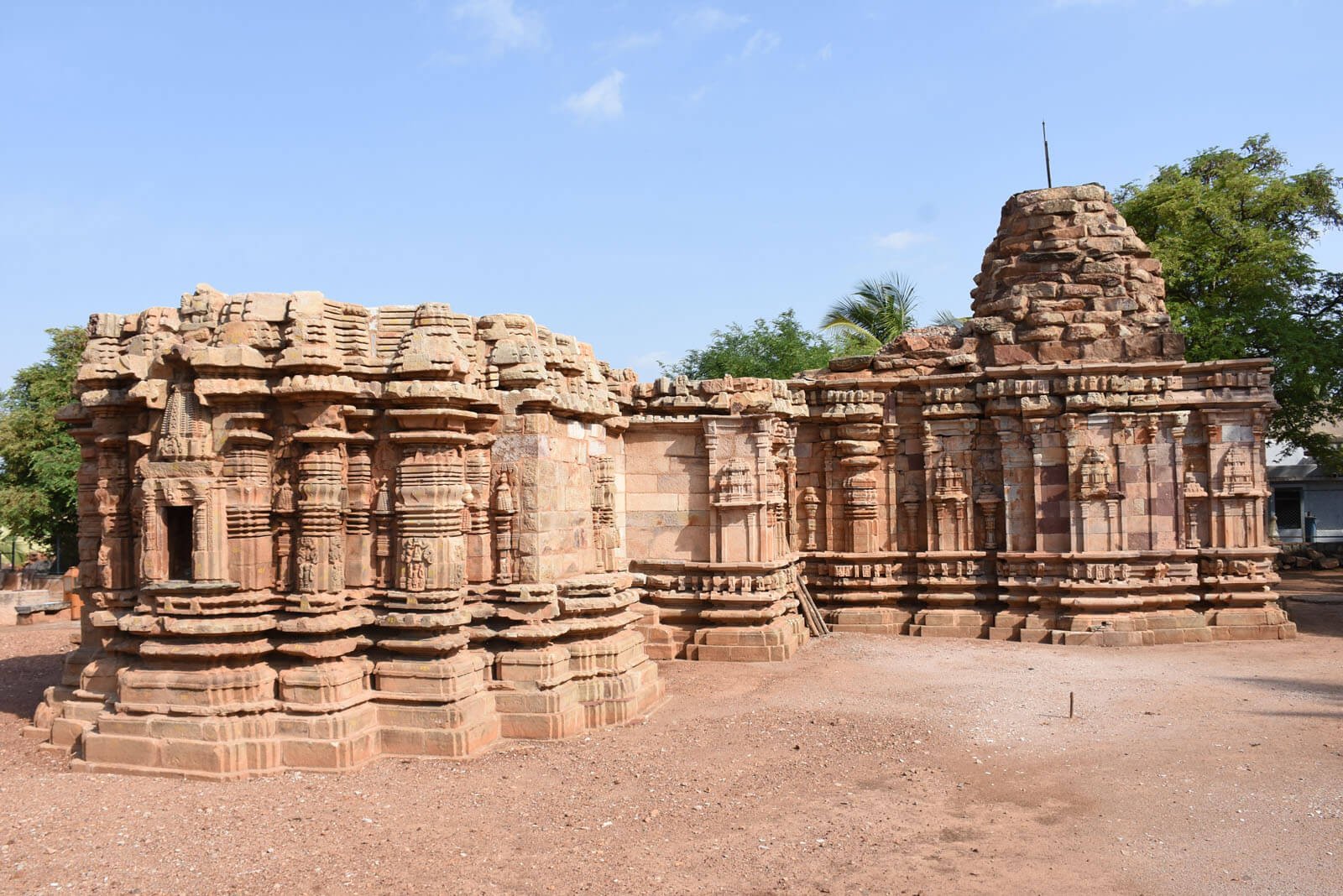
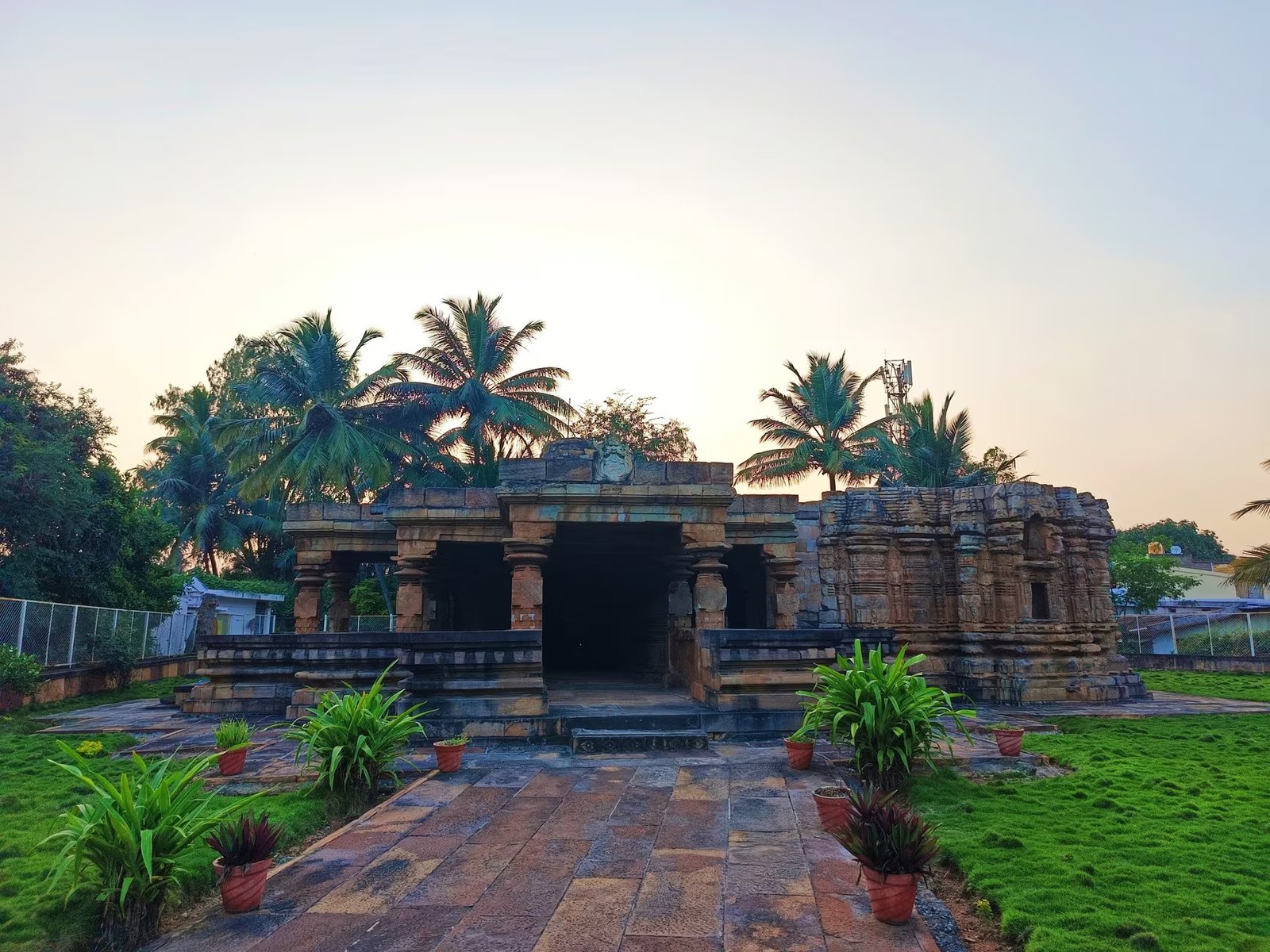
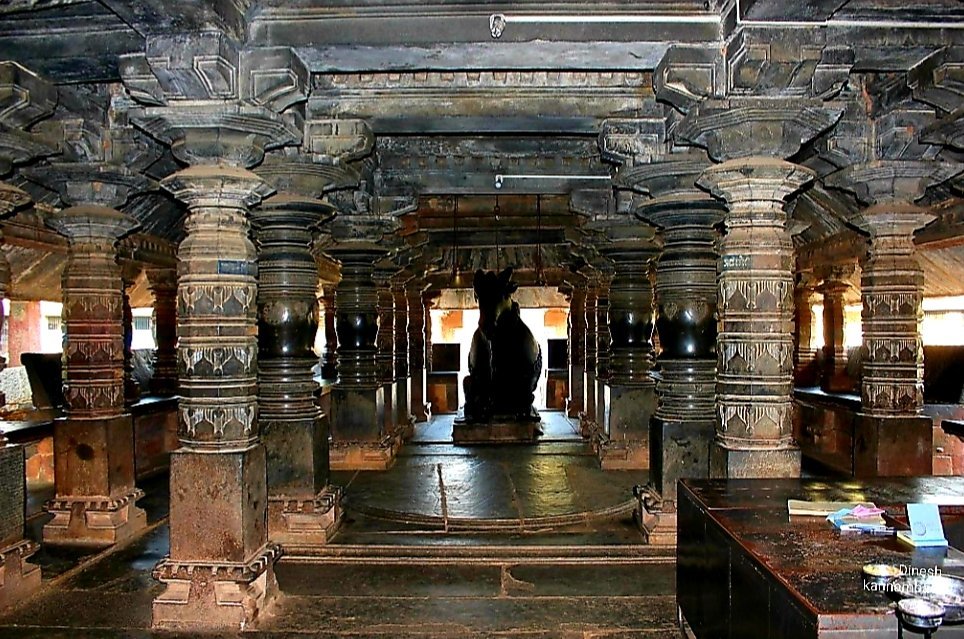
What makes the Banashankari Temple architecturally exceptional is its Dvikuta design — a rare double-sanctum structure that combines two distinct styles of Indian temple architecture under a single roof. The first shrine, facing east, is built in the diamond-stepped Nagara style, characteristic of North Indian temple design. The second, facing south, follows the Dravida tradition rooted in South India. Both shrines have their own antharala (antechamber) and ardhamandapa (intermediary hall), and both open into a shared Navaranga — a common gathering hall supported by eight square pillars, each carved with divine figures.
East shrine (Nagara style)
Houses a mutilated image of Bhairava on a pedestal. Diamond-stepped superstructure in classic North Indian form.
South shrine (Dravida style)
Houses a Shivalinga. Built in the South Indian Dravida tradition with a distinct vimana (tower).
Navaranga (common hall)
Eight four-sided pillars carved with Shiva, Vishnu, Ganesha, Nataraja, Narasimha, Surya, Varaha, Saraswati, and Manmatha.
The Saraswati inscription
One pillar bears a carving of Goddess Saraswati with her name inscribed below in stone — the only deity so named in the entire temple. Possibly an Akshara Abhyasa centre.
“When I closed my eyes inside the Navaranga to feel the vibrations, I felt I was witnessing a celebration of a bygone era — this particular Navaranga is very small in size; was it to make the person feel very special? Possibly yes.” — Temple Tales, 2024
The exterior walls hold their own surprises. Carved onto the rear face of the temple are figures that stop visitors mid-step — a woman dressed in what appears to be a middy blouse, and another figure so unusual in posture and proportion that at least one visitor has described it as resembling an extra-terrestrial. Whether these are artistic anomalies, symbolic carvings, or something far older and stranger, nobody has yet offered a definitive answer. The temple keeps its secrets well.
What the name carries
Banashankari — or Vana Shankari — translates as the goddess of the forest. According to tradition, she descended from the heavens at the request of the gods to destroy Durgamasura, a demon whose terror had become unbearable. She is an incarnation of Parvati, fierce in purpose but ultimately a protector — and the temple built in her honour carries that same dual quality: ancient but cared for, worn by centuries but not defeated by them. The main deity is Goddess Parvati seated as Banashankari, installed in the southern sanctum alongside the Shivalinga, and the Navaranga Mandapa celebrates the entire Shaiva and Vaishnava pantheon in stone.
How ASI saved it
The Archaeological Survey of India has carried out significant conservation work here, and it shows. The western section of the temple, which housed the Bhairava sanctum, had become structurally unstable and was dismantled and carefully reconstructed. According to those familiar with the work, the reconstruction was executed with such precision that it is virtually impossible to tell restored stone from original. A proper compound wall, a garden within the premises, and ongoing preservation efforts have given the temple a dignity it deserves. The beauty and originality have, by most accounts, been wonderfully conserved.
Visitor tip
Photography inside may be restricted — mobile photography is generally permitted but confirm with the caretaker on site. The temple is located on a mound within a residential neighbourhood in Amargol, about 9 km from Hubli city centre and 4 km from Unkal Lake. Entry is free. Best visited in the morning. Shivaratri (February–March) draws the largest number of devotees.
Places nearby
- Chandramouleshwara Temple
- 4 km
- Unkal Lake
- 4 km
- Nrupatunga Betta
- ~7 km
- Bhavanishankara Temple
- 8 km
- Siddharoodha Math
- 9 km
- Indira Gandhi Glass House Garden
- 8 km
To visit the Banashankari Temple at Amargol is to step outside the noise of modern Hubli and into something that time has treated with unusual care. The caretaker will walk you through every carved figure. The old Kannada inscription will stare back at you from the stone. And the Navaranga — small, intimate, vibrating with something you cannot name — will make you understand why the people who built this place believed they were not working in stone, but in eternity.
Practical details (timings, parking, fees) can change. Confirm locally before you travel. This guide is for general orientation only.
Looking for farmland or a residential plot around Hubli–Dharwad? Hubli Realty helps with site visits, title checks, and fair pricing.
+91 8951355896 View farmland